


Sixteen years after the fire that destroyed St. Jude Hospital and claimed the lives of three patients, the facility was formally handed over to the people of Saint Lucia on November 16th in a ceremony led by Prime Minister Philip J. Pierre. The handover marks the end of one of the country’s longest-running and most contentious public infrastructure projects.
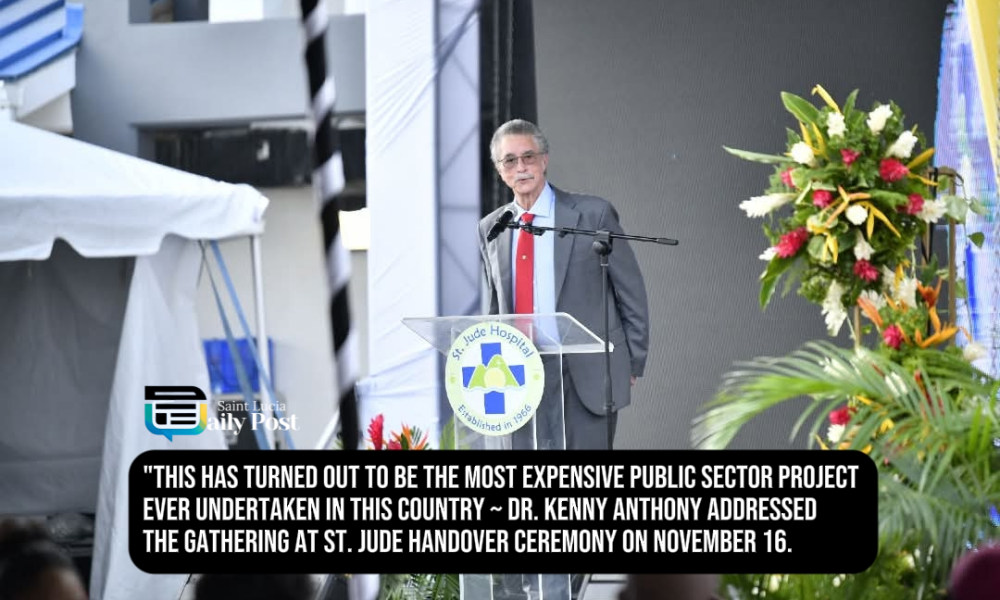
St. Jude Hospital was razed by fire on September 9, 2009, killing Mernus Vigier, Claudius Soudine, and Joseph Jn Baptiste. The hospital was relocated temporarily to the George Odlum Stadium, an arrangement that was expected to last months but stretched into nearly two decades. Over the years, the project became the subject of political disputes, shifting construction plans, and significant public expenditure. By 2016, more than EC$200 million had been spent, but the hospital remained incomplete. Subsequent work on a separate structure commissioned by the Allen Chastanet led United Workers Party government, dubbed “The Box” also came to a halt and was never commissioned.
Prime Minister Pierre acknowledged the lengthy delays and the decisions taken across successive administrations. “Sixteen years is a long time. Too long,” he said. “My government could not allow this situation to continue.” His administration opted to discontinue work on “The Box” and instead resume reconstruction at the original site. Financing for the restarted effort came largely through a USD $69 million concessionary loan from the Saudi Development Fund. Pierre described the handover as the conclusion of a protracted period of uncertainty for the South and paid tribute to frontline staff who operated out of the stadium. “They kept St. Jude alive when it could have easily been forgotten,” he said.
St. Jude Hospital CEO Lydia Atkins reflected on the emotional weight of the moment and the lasting impact of the 2009 tragedy. “This is a day we have carried in our hearts for sixteen long years,” she said. “The three lives we lost are woven into the foundation of this new beginning.” Atkins praised the resilience of staff who worked at the temporary facility, calling them “heroes in scrubs” who continued providing care despite limited space and resources.
Permanent Secretary in the Ministry of Health, Paul Hilaire, referenced the long and complex reconstruction journey and credited several international partners including the Republic of China (Taiwan), the Saudi Development Fund, and the government of Mexico for their support. He noted that the project required restarting elements of the original design and addressing earlier deficiencies and acknowledged former Prime Minister Dr. Kenny D. Anthony for initiating difficult decisions early in the process. “This edifice is not merely a hospital. It is a symbol of renewal and public trust,” Hilaire said.
Contractor Rayneau Gajadhar offered a candid account of the pressures behind the reconstruction, describing financial and operational risks taken to speed up the work. “Had I followed every rule and waited, this would have been a four-year project,” he said, noting that international partners expressed strong support for the government’s determination to complete the hospital.
The completion of the original St. Jude Hospital brings an end to years of political dispute and widespread public frustration over the stalled project. For communities in the South, the handover represents both a return to a permanent healthcare facility and the closing of a difficult chapter in the country’s recent history. The hospital is expected to begin phased operations following final preparations by the Ministry of Health.